I Am a Killer

Photo by Craig Lloyd on Pexels.com

Docuseries: I am a Killer
Available on Netflix
5/5 Stars

Knowing that every inmate in this series is safely locked behind bars did not take away from the “creep” factor of it. I am a Killer is dark, twisted, and creepy. It’s also fascinating and I was really disappointed when it came to an end. The series is super well done, as it brings together interviews from the convicted, interested parties, detectives, prosecutors, family members, and the community. You will see and hear it all and, if you’re at all like me, you’ll be completely gripped…..and confused.

Each segment is 45-50 minutes long and views like a mini-movie. No narrator is available (lending to the “creep” factor I mentioned above.) Snippets of facts are written on the screen, detailing the crime, while interspersing personal interviews with various people, most notably including the person convicted of the crime.

The interviews with the incarcerated is what is most compelling about this series. Not a single one of them claims innocence, but the degree to which they take personal responsibility for their actions differs from person to person. Also very compelling are the wildly different views presented of the crimes themselves. Once you finish listening to the convicted person you might think one thing, and then listening to the cops involved or family members and you’ll question everything. It’s very psychologically interesting.

The cinematography is super well done, with shots of the prisons and crime scenes. The interviews don’t leave much out, so viewers will certainly feel a lot of the pain from the crimes.

In the end, the entire series is so well done, you won’t want to stop watching it. I wanted to hear all sides of the stories presented. I wanted a conclusion. My only small complaint was that some sides weren’t told. (In other words, sometimes families would not talk on camera, or other people involved. I can’t say that I blame them, but sometimes bits were missing that left me wanting to hear the “whole” story.)

If you enjoyed Unsolved Mysteries from the 90s or some of the 20/20 true-crime stories, you will enjoy this series. If you’re like me, you’ll feel some guilt over giving these people a voice. That said, they also give a voice to families and friends, and I think it’s important from a psycho-social perspective to try to understand why people do what they do.

You will learn a lot watching it and I hope that you do. Leave me a comment after you watch it and let me know what you think!
Crazy Bootcamp fun!

I’ve written about Sydney Cummings before, because I’m such a big fan. But, I felt compelled to write again because this bootcamp is, bar none, my favorite bootcamp workout EVER! It’s sports inspired and super fun. Best of all, I was positively dripping in sweat about 15 minutes into it!

2 exercises in each set, 4 sets each, all in sports-themed drills:

  • Soccer
  • Volleyball
  • Baseball
  • Hockey
  • Kickboxing

Enjoy!

Outside Man

This little clip is just a sample of the crazy things you’ll see and hear when you watch the BBC series Outside Man – available on Netflix. I guarantee you that it’s worth your time. I easily give it 5/5 stars!

The narrator of the series is Reggie Yates, and I confess that I’ve never heard of him until now. At this point, I’m a big fan. He tackles everything from severe drug addiction in Australia, to body dysmorphia among men in the U.K., and modeling for young girls in Siberia. If that sounds like a crazy-wide range of things, it’s because it is. That’s the beauty of this series – it’s fascinating, because it is so all over the place.

Outside Man is set up like a television mini-series, in 50+ minute clips for each section. Within each section, there are multiple episodes. One section is all about Africa, with sections about apartheid, evangelism, and gangs. Another section is about Russia, with sections about over-patriotism among youth, white supremacy, gay rights, and the modeling industry. Next up is the U.K., with sections about male body dysmorphia and homelessness. And, last up is the U.S., with sections about gun violence and black lives matter. (What is particularly disturbing about the U.S. shows is the BLM movement. It’s shocking that the series was made several years ago, and here we are again still fighting for basic rights to live without fear for African Americans. Clearly, a follow-up series is needed.)

It’s amazing how much I learned during the series. Just a few tidbits:

  • Gang violence and reverse racism is alive and well in South Africa. Wow – it’s crazy.
  • Body dysmorphia exists in men, as it does in women, and it’s scary what people do to themselves in the name of vanity.
  • Young girls in Russia are subjected to the most awful things in the modeling industry, just to satisfy the greed and over-consumerism of the west.
  • Racism, homophobia, and violence are not unique to the U.S. Unfortunately, all of these things exist elsewhere too.
  • The “men’s rights movement” is actually a thing and it’s just as gross as it sounds.

It took me quite a few sessions on my treadmill to make it through the entire series on Netflix. But, I was so disappointed when it ended! Get ready to pull out the kleenex for some tears. And, definitely be ready to roll your eyes a lot and to talk back to your iPad screen. (I spent quite a lot of time talking to people on the screen, saying things like “you did NOT just say that” and “what is wrong with you?!?)

It’s an important documentary and you will not regret watching it. Let me know in the comments section what you think of it!

In Defense of Farmers

I recently posted a video such as the one above on my Facebook feed, with a note that this sort of behavior was horrific, etc. I received an interesting comment which inspired this post. My commenter stated that not all farmers are “bad” and that these kinds of videos only show a little clip, so we don’t really know what else goes on. It was also suggested that people only need to make a living, etc. I need to unpack that a little.

First, I absolutely agree that not all farmers treat their animals like they do in some of the (MANY) videos that PETA and other animal rights organizations have recorded during undercover operations. That said, I don’t care if pigs, chickens, and cows are given personal massages and manicures every day of their short lives if the “farmer” is only going to slaughter them in the end. People don’t need to eat meat to survive. (I am living proof of that…happily vegan for 12 years now.)

Second, the argument that people working in dairy, meat packing, etc. are “only trying to make a living” does not wash. Times change and people have to adapt. If the world goes vegan (heaven!) then people working in dairy and meat will have to change and work in a different field. When cars were invented, they weren’t forever banned to save the jobs of the horse and carriage riders. In addition, I think it’s important to point out that there are lots of perfectly legal jobs that I find appalling, that I would never want to save simply because “that person needs to make a living.” Just a few examples:

  • Televangelist: Frauds taking advantage of people, particularly right from their wallets, without any benefit to anyone but themselves. I’d love to find an exception, but it hasn’t happened yet.
  • Telemarketers: I hate random telephone calls with people selling things. This goes double for people showing up at the front door selling stuff I don’t want or need.
  • Executioners: Really, the guy who has to kill people on death row. Just doing his job, right?
  • Dishonest politicians: I guess I don’t really need to add a description to this one.

In the end, employees working in factory farms, the dairy industry, and meat packing plants can choose to do something else. Big farms can opt to close, and the best part is that they do. My favorite example is “Rowdy Girl Sanctuary.” Once upon a time, this amazing animal sanctuary was a working cattle ranch! If this wonderful organization managed to make the switch in Texas of all places, others can too! Here’s a little clip about Rowdy Girl:

So, it’s time to make a change. And, that change starts on your plate. Ditch the meat. Ditch the dairy. Go vegan today.

If you have recently made the change, be sure to leave me a comment. I’d love to hear all about it! Be inspired. 🙂

All that Tae bo Fun

Trapped at home during the COVID nightmare, so you can’t get to the gym? Bored out of your mind with whatever routine you’re currently doing? Go old school – give Tae bo a shot!

Tae bo was phenomenally popular in the 1990s and I can personally credit it with helping me lose 40 pounds in the late 2000s. It was created by Billy Blanks, a winning martial artist with numerous martial arts awards, including 7 world karate championships. He knows what he’s doing, and best of all, he’s inspiring!

The workouts are easy to follow, fun, and leave you sweating. They are part dancing and part kickboxing party. Best of all, even though most of the videos were created more than 20 years ago, they are still fun!

Unfortunately, they aren’t always easy to come by. Amazon Prime has only one of the videos available on streaming. YouTube has several, which is great. (My absolute favorite Tae bo workout is linked above, with my 2nd favorite below.) Tae Bo Nation has a streaming service available, but $30 a month is (literally) twice a month what I am paying for Les Mills online (which includes Body Combat, a similar program) so I haven’t committed to trying it out yet. Combining Body Combat workouts 2-3 times a week, with 1 or 2 YouTube Tae Bo videos workouts a week has been working great for me!

One word of caution….I suggest trying to stick to the “old” workouts from the 1990s. I have tried some of the newer creations, and though they are fun too, they just don’t compare to the originals in terms of “fun” and routines.

Enjoy! If you like Tae bo too, drop me a line. If you know of similar fitness programs, be sure to let me know in the comments.

Animalkind

Photo by Pixabay on Pexels.com

Animalkind
By Ingrid Newkirk & Gene Stone
4/5 Stars

Animalkind is all about animals, big, small and everything in between. The book is part text-book, part fun facts, and part action-oriented. Bottom line – it was interesting!

Animalkind was written by 2 activist writers – the founder of PETA, and a plant-based author, so the book comes from an animal-rights perspective. However, the first half of the book is really about animals and how they behave, rather than what we can do to help them. (Suggested actions to help animals are saved for the latter part of the book.) Although I have been a vegan for 12+ years, and a PETA member, I always learn something new in a book like this one. Honestly, I was so fascinated by how awesome and interesting animals are that the book made me want to go back to school for a degree in biology, simply for fun. Just a few tidbits:

  • Dragonflies can propel in six directions and they fly up to 30 MPH.
  • Elephants can discern the difference between male and female roaring sounds.
  • Chickens chirp to their babies while they are still in their shells and the chicks talk to their mothers from inside their shells.
  • Southern right whales participate in a sort of courtship diving series. If the female is unimpressed with the male’s moves, she goes in search of a more graceful partner.
  • Albatross marriages almost always stay together, which can be 50 years!
  • Pigeons also mate for life and they share child-rearing duties.
  • Macaques (snow monkeys), fruit flies, albatrosses, and chimpanzees (especially bonobos) and often-times bixsexual.
  • Octopuses are super intelligent and can “solve mazes, use tools, distinguish between shapes and patterns, and learn through observation.”

In addition to learning about really amazing things about animals, readers will be able to learn about how animals have historically been used in scientific research, as clothing, in entertainment, and of course, as food. I found the history fascinating (sometimes with references hundreds, if not thousands, of years back.) Of course, learning how animals are used today wasn’t any picnic, but that’s why the author expounds quite a bit on “revolutionary new ways to show them compassion.”

If you enjoyed any of James Herriot’s veterinary/animal books, you will enjoy this book. This book has a lot of animal “stories” that reminded me of his books.

The book easily earns 4/5 stars. I knocked off one star because I did not find the ways to show compassion “revolutionary” because I didn’t see anything new to do. (I confess that this is a little unfair since I have already been a committed vegan for over a decade.) Also, some of the animals-facts were a little wordy. That said, I really enjoyed the book and found lots of new and interesting information in it. For instance, I had absolutely no idea that aquariums are just as tortuous for animals as places like Sea World are…..so, no more aquariums for me!

Give it a read and let me know what you think. If you have similar books to recommend, please let me know! I am always looking for new animal books to read.

Scott HMX Carbon Cycling Shoes

Of all my time spent doing athletic things, bicycling is my favorite. I’d rather be bicycling than just about anything! I’ve been a cycling enthusiast for more than a decade now, and the biggest lesson I’ve learned (the hard way!) is that proper gear is everything.

Unfortunately, I am prone to “hot spots” on the bottom of my feet. They tend to land right under my toes, and sometimes spread through the middle of my foot, mostly on my right foot. Ice packs, ace bandages, yoga – all of these things help. But, really, proper gear helps the most.

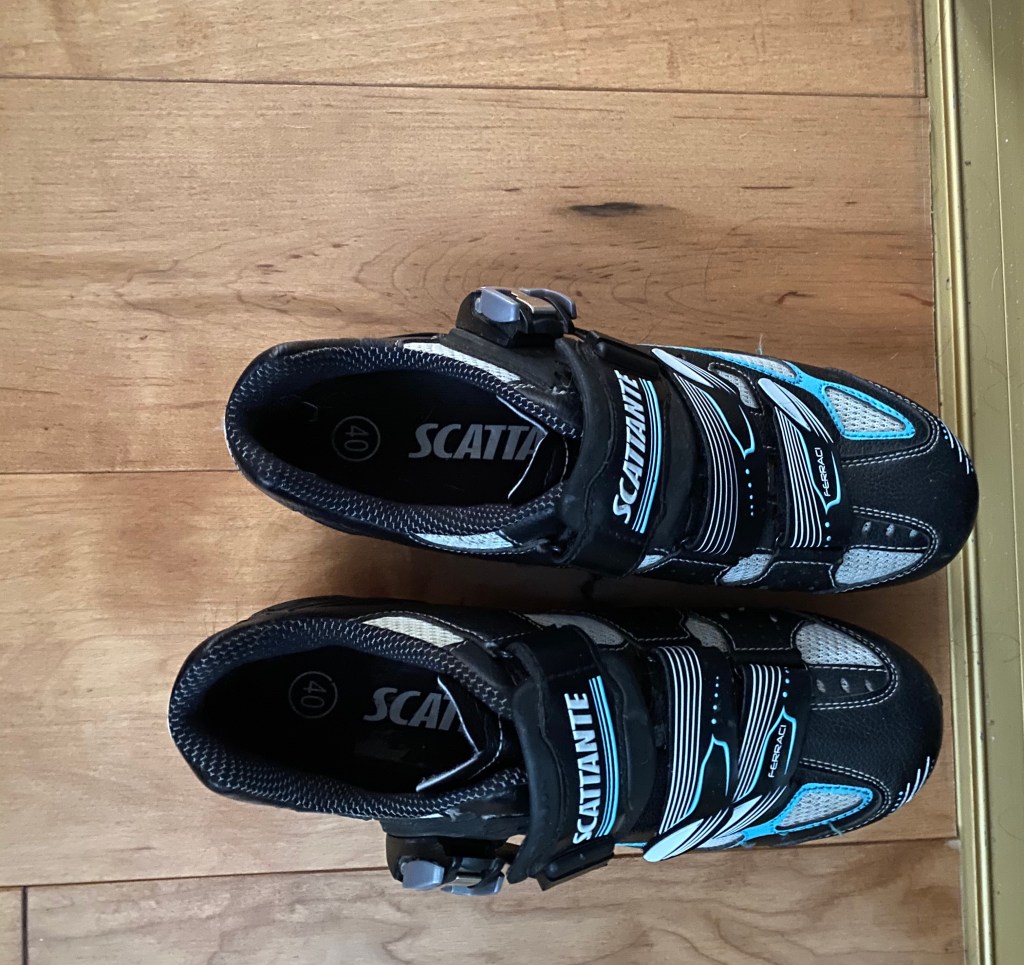
I’ve been using my extremely trusty Scattante shoes for more than a decade. As you can see, they are in pretty-much perfect condition after mostly daily use, for literally more than 10 years.

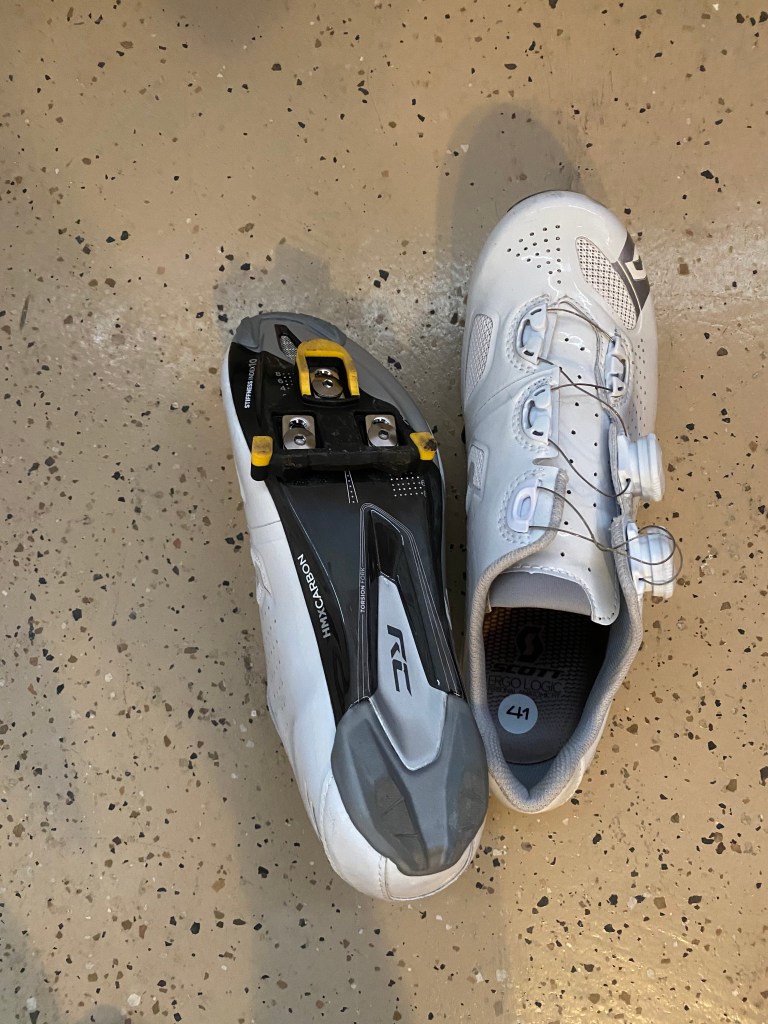
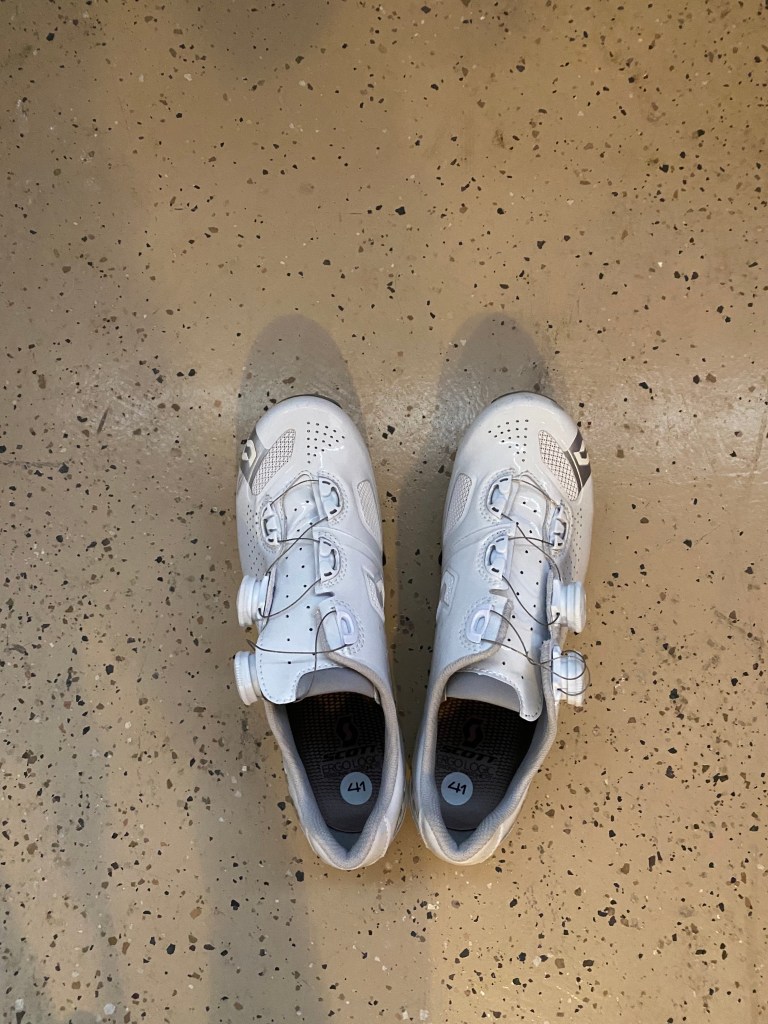
But, it was time for a change, so my sweet husband bought me a pair of Scott HMX Carbon Shoes, which coincidentally go nicely with my current Scott road bike! I was hesitant to give them a fair shot. (Let’s be honest – I’m still hesitant. My Scattantes are still in the closet and they don’t have cleats on them. I can’t seem to part with them because I have so many AWESOME bicycling memories associated with them!)

I’ve now used my new shoes on two 25-mile+ rides and they are a literal dream. They are so danged comfortable that I have compared them to floating on a cloud. The shoes have extra padding on the bottom, and a nice wide toe box for extra comfort. They’re also super nifty in that they don’t have any velcro straps. Instead, they have not one, but two, twisting knobs for closure. And, best of all, you can twist both directions (which is super cool, when you’re used to having to pop the knobs up and start all over again during rides when your feet swell over time!)

As you can see from the side view, they are rigid with a bit of flex, and they come with vents.

And, of course, cleats are always needed!

Best of all, my most current annoying hot spot (located just below my third and fourth toes) has gone from a pain level of 8/10 to a max of 2/10 in just 2 rides!

If you’re looking for a comfortable shoe, with some flex and ease of use for adjustments, look no further. They are available on a few websites, but here is the main Scott site: https://www.scott-sports.com/us/en/page/carbon-cycling-shoes.

Good luck! Get out there and ride, ride, ride!

Sydney Cummings

Photo by Pixabay on Pexels.com

Workouts with Sydney Cummings
Available on YouTube
5/5 Stars

Stuck at home during the COVID-19 pandemic and still want a good workout? Can’t get to the gym when classes are available? Bored to tears with your usual routine, and looking to mix it up? Look no further – Sydney is the answer.

My local gym offers a “bootcamp” class on Sunday mornings, just before my usual UJam class, and it’s a great way to end the week. So, in an effort to mimic what I usually do at the gym during the COVID shutdown, I went online in search of “bootcamp” style workouts and I randomly found Sydney. I liked the first video I did so much that she has become a regular part of my Sunday morning routine for 3 months now! I like her so much that I might just continue to do her routines instead of going to the gym when they reopen.

Sydney’s workouts are all circuit-style and can be found in 30/40/50 or 60 minute blocks. I started with a 30-minute bootcamp, and have focused on the 50-minute workouts since that first one. I love them because they are fun, never boring, get your body working, and (most importantly) they offer a variety of exercises.

I’ve focused on “boot camp” style workouts, with the exception of this morning when I randomly chose to do a “sculpt and sweat” workout, which was a really great full-body workout for sure! (Here is the link to the routine I did this morning: https://www.youtube.com/watch?v=845XSOpuYYg. My Apple Watch says I burned 200 calories in 48 minutes. I can compare that to a traditional BodyPump workout where I generally burn 140ish calories in 50 or so minutes.)

Sydney always works in circuits or sets. So, using hand weights, body weight, or some sort of cardio move, you work for say 45 seconds, rest for 20 seconds, then do another exercise for 45 seconds, rest for 20 seconds, etc. Usually she has you work on 2 different moves (sometimes it’s 3) with 2-3 rounds, and then on to the next. Every workout I’ve done so far has been a fabulous HIIT routine. (This morning’s workout shows an average heart rate of 85, with a low of 52 and a high of 104. Not too shabby for a sculpting routine.)

The best thing about Sydney’s workouts is that they offer such a variety of exercises. I’ve done 10+ different routines, and I can honestly say that I’ve only done one move more than once. (Unfortunately, 2 videos had burpees which I hate, but I’m sure I’ll survive.) I’m amazed that she can be creative enough to creative 50 minute routines with no repeating exercises!

The routines are easy to do at home with minimal equipment needed. They are fun and interesting and Sydney has really good energy. And, since they are posted on YouTube, they’re free to use! It’s worth the price of watching some ads.

Give one a try and let me know if you like them as much as I do. Have other similar recommendations? Please let me know!

Udaya

Photo by Cedric Lim Ah Tock on Pexels.com

Udaya is an online streaming platform that enables you to do yoga from the privacy of your own home, at your pace and when your schedule allows it. My experience using Udaya was disappointing, so I am giving it 1/5 stars.

COVID-19 has forced the shutdown of gyms, yoga studios, rec centers, etc. As a result, many of us, myself included, have been forced to shop around online for ways to continue working out from home. (Thank goodness this particular pandemic happened to land during the internet age. If this had happened during the 80s, I would have lost my mind by now for sure!) A simple YouTube search for yoga videos led me to an instructor by the name of Travis Eliot, who I’ve pretty much decided is my favorite yogi of all time. That said, there are only 2 full-length videos available on YouTube of his classes, but there are ads directing you to Udaya. So, I signed up for the service, expecting the best.

PROS: There are a lot of different videos available to choose from on the site. That’s about it.

CONS:

  1. The search function is abysmal at best. Users can choose to search by instructor, length of session, type of yoga, etc. However, once you do a search and decide on one to look at, you can’t back out to your original search if you don’t like the one you chose. In other words, you have to start your search all over again which is a royal pain.
  2. The search results aren’t accurate. For instance, I chose a “power” class for one of my sessions and found myself so bored I was ready for a nap. (That particular class should have been classified as “restorative” or maybe “yin” – but “power”, no way.) Also, the length of sessions is totally inaccurate. When asking for “60+” minute classes, I get back 50-55 minutes or so per session. Maybe that’s nit-picking, but when I say I want a 60 minute class, I want a 60 minute class.
  3. Some of the yoga styles are really under-represented. For instance, when searching for an ashtanga class, I came up with under 10 videos total. For a site that claims to have thousands of videos available, that seems pretty lacking.
  4. There are extra charges beyond streaming. Remember the instructor I really liked that led me to the site in the first place? Well, the 2 videos available on YouTube are also the only 2 videos available on Udaya. If you want the rest of his collection, you have to buy it. Really? What’s the point of paying for an online subscription service if I can’t access the videos I want?
  5. The instructors aren’t great. Over the 2 weeks or so that I tried the service, I tried quite a few instructors. Honestly? Meh.

Obviously, it’s preferable to practice yoga in a studio setting with other people. But, given that it isn’t always an option (certainly during a global pandemic) options are needed. But, I wouldn’t recommend this one. I just signed up for Gaiam online. I’m hoping for better results.

If you know of other outstanding online yoga classes, please comment! I prefer really moving in a yoga flow (vinyasa, power, ashtanga….anything that gets the heart moving!)

When Others Shuddered

When Others Shuddered
By Jamie Janosz
4/5 Stars

Though there are many women who have fought, and fought hard, for things like women’s rights, environmental concerns, etc., there are 8 special women in history who fought for social change and Christian education. The work of these 8 women are detailed in this book, in a flowing illustrative way, including loads of personal details gleaned from books and letters, as well as some conjecture in the form of personal details to give the descriptions some animation.

The book is organized by person, and gives a short background of each woman’s personal history. Her passions, accomplishments, and dreams are detailed and interwoven throughout the text as the author gives more and more information about what her life’s work was and how it affected the community. I enjoyed the personal histories quite a lot. Some of the conjecture-prose was a bit dry, and quite a lot of the details in the book focused on missionary work for evangelizing, rather than on the work each woman did for the community. (I realize this is perhaps be expected from an author who is a professor at Moody Bible Institute, but I would have preferred a focus on the work of the Church from a works perspective, rather than an evangelizing perspective, thus the 4/5 stars.)

Of the 8 women profiled in the book, my 2 personal favorites were Virginia Asher and Mary McCleod Bethune, again because of their focus of social work during their lifetimes. Virginia Asher intentionally ministered to women who were outcast in society, specifically women working in brothels. “She was called an ‘angel of mercy’ and a friend to these women who society had rejected.” I have done some volunteer work with women subjected to sex trafficking, so I can appreciate what she was doing. It’s amazing how horribly we treat each other. Mary McCleod Bethune rose from working in the cotton fields in the South after the Civil War, to working with the President on educational initiatives. She fought tooth and nail to open schools for African American children in the South, in a time when it was pretty much impossible to do so. Mary was refused missionary work in Africa based on the color of her skin, so she worked for people in the South with her head held high. “Mary Jane refused to look back. She would continue to follow her God. He had provided a way out of the cotton fields, and He would certainly open a new door so she could serve Him.” Mary McCleod Bethune inspires me now, 150+ years after her death.

Whenever I read a book about service, history, oppression, etc., I try to think of what action I should be taking as a consequence of reading it (particularly when one of my books comes from the United Methodist Women’s reading list, as this book did.) What can I do differently after reading the book? How can I serve in a new way? What have I learned and how can I apply it to my life? For me, it’s all about service. I am looking around now and thinking about how I can be of more service to my students and their families.

If you like books about history and about Christian service, you will enjoy this book. If you are inspired by it, or decide to do something different after reading it, definitely make a comment. I would love to hear your thoughts.